Christopher Lennertz: Let the Story Be the Boss
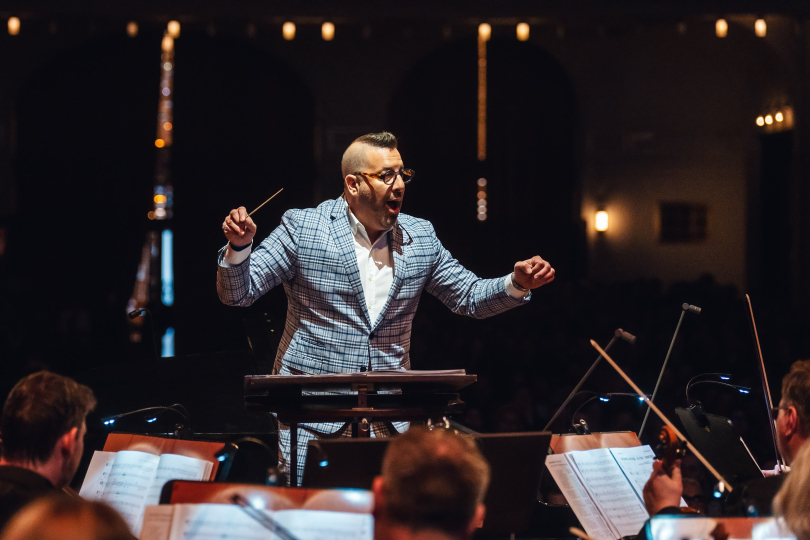
At the Composers Summit Prague, Christopher Lennertz arrives not only as an established voice in film and game music but also as someone who clearly enjoys the craft and the people around it. His scores—whether for big studio films or major games—carry a sense of drive and clarity that reflects his hands-on approach. In this interview, we connect his journey to the summit’s spirit, where composers exchange ideas and experiences. Lennertz speaks about collaboration, staying curious, and what it truly takes to keep growing amid the demands of a fast-moving industry.
Christopher, you started as a trumpet player, which is already unusual for someone who would become an orchestral and hybrid composer primarily. But before USC, before Elmer Bernstein, before any of that, there was a moment. You watched Henry Mancini receive a note during a scoring session, sit down at a piano, and rewrite a cue on the spot—from classical to jazz—in ten minutes. You changed your major the next day. For this room of musicians: what exactly did you see in that moment that you hadn't seen before?
I had been playing music since I was nine, starting with trumpet and switching to guitar at 12. I played in rock bands and theater—I was the lead in Bye Bye Birdie—and sang in choir and performed classical music. What often frustrated me was that I liked all these different styles—Metallica, Van Halen, Rodgers and Hammerstein, Stephen Sondheim, and I also liked Bach, Beethoven, and choral pieces—but people would say, “Classical music's not cool. Play rock guitar,” or “Rock guitar's not cool. Play jazz.” That day, watching Henry Mancini, I saw him rewrite two orchestral cues into jazz on the spot at the producer's request—and everyone was happy. That was the first time I realized this was the one job where being able to do all styles was an asset. It was cool to blend hip-hop, orchestra, jazz, Latin—every different style of music.
And you spent four years assisting Basil Poledouris—moving boxes, eventually orchestrating. Poledouris had this extraordinary ability to write thematic music with a kind of primordial weight—think Conan, think The Hunt for Red October. Large brass, modal harmonies, almost pre-tonal in spirit. Did working inside his scores change how you think about harmonic rhythm—the rate at which chords move under a theme? Because it's something composers talk about abstractly but rarely dissect.
Basil wrote simple, bold themes like Conan. They had a lot of force. They had a lot of gusto. And I loved that. And I think that was something that I fell in love with right away with his writing. I write a lot like that today. I like to do big French horn themes—not lots of notes, just power, lots about power. He did that so, so well. Plus, another thing he did well—and Michael Kamen often did too—was write action music in odd meters. They’d write it in seven, and they would write it in five, and it would be all this stuff. And I was like, “Oh, that’s great,” because it’s so interesting and unexpected, you know? And it’s exciting. I love that from him. I loved learning that from him.
You’ve mentioned Michael Kamen—you spent six months at his studio, which you later replicated in your own home. Kamen was the bridge builder: rock and orchestra, Brazil, Die Hard, Robin Hood. He seemed constitutionally opposed to the purity of genre. Did he have a methodology for that? Or was it intuition? And is there a difference in how you notate a cue that's meant to feel genre-unstable?
When Michael sketched, there was never a click track. Never. He would watch the movie, and there was lots of rubato—it would get slower, it would get faster, it would get bigger. And that’s one of the things I loved watching. And I think part of that was because he came from—especially, you know, he did strings for Pink Floyd—so he came from the world of making records, and there was never a click track in a record. A lot of it was freedom and passion. You could change tempo like this if you wanted to. And that’s something that he did all the time. And I watched, and I said, “Oh my God, this is a whole new way of writing. It can be fluid.” And that was good. And then the other thing—because he had already worked with Eric Clapton and Aerosmith, and then after I was there, he worked with Metallica—so when he wrote aggressive music, it almost sounded like rock and roll. And that was really cool. And I think a lot of my music feels like that, especially for The Boys.
The Boys—let’s spend some time here, because what you described doing to that score is genuinely unusual as a technique. You recorded a full orchestral score in Budapest. Then you ran it through hardware processing—pitch-shifted it, slowed it down, in some cases reversed sections of it—to make what should have sounded heroic feel corrupted. From an orchestration standpoint, which instruments survive that processing most interestingly?
I think long notes do better than short notes. The things that sound the best are big, long notes. If you play a melody and you get to a big chord or big note and then you pitch it down, descend, it sounds really great. The long notes and the low notes seem to be better in the lower register. A lot of times in the show, we usually pitch trombones and cimbasso, as well as basses and cellos, and we record them separately. There are even some cues that you'll hear where the trombones and cimbasso will go down, and the basses and the cellos will go up at the same time, so they get spread. And that sounds cool, especially when we're leading into an accent or a jump scare. The fast things don't sound good, especially percussion. When you change the pitch, you don't really notice it because they’re mostly transients—attacks. Long notes tend to work the best. And then what we noticed is that if you take a two-bar note—like one note for two bars on a French horn—you don’t really notice the corruption or distortion. It just sounds like the player’s doing it for about a minor third. The first minor third sounds natural. You must go further than that to make it sound corrupt. Otherwise, it just sounds like embouchure. So almost all the time, I go at least a fifth, sometimes an octave. And then, especially when Homelander’s really angry, sometimes we’ll even do two octaves. And sometimes we only do pitch—it doesn’t change tempo. But sometimes, especially if he’s unstable, we also slow it down. Thus, not only does it go down two octaves, but it also stretches out. Sometimes it takes 25 seconds for one note. It’s uncomfortable. Mostly in this last season, I have to say, because he’s getting crazier.
There’s a philosophy question underneath that technique. Does that represent a genuine paradigm shift, or is it a tool you pick up and put down depending on the project?
It’s a tool that I pick up and put down. I also feel like it’s a bit of a signature for The Boys, so if I did it in a different project, everyone would just say, “You’re doing The Boys.” I almost feel like I’m not allowed to do it anymore. I might do it differently—maybe reverse something. I think affecting the orchestra is fun. Even when I look back at Jerry Goldsmith in Patton, using digital delay, I’ve always thought that was interesting. But I don’t know that I can pitch the same way again, because it’s already associated. I am interested in other things—reverse delay, spatial movement. Especially now with 7.1 or Atmos, you could move the orchestra physically. French horns are usually on the left, but in Atmos, they could move overhead or behind you. If it serves the story, that’s interesting. If you’re doing a horror or thriller and someone is losing control, you could take something heroic like French horns and displace them in the space. That’s a way to serve the narrative.
Talking about that kind of approach—Agent Carter. 1940s New York, a jazz-inflected spy thriller. How did you approach the jazz vocabulary?
Yeah, it wasn’t perfectly accurate. Post–World War II would’ve been bigger band—like, Glenn Miller, “Take the A Train,” that kind of thing. Whereas I think I used more 1950s harmonies—more like early Miles Davis or even Thelonious Monk—because I used a lot of bass. I think I did that because big band doesn’t sound like spies. And Agent Carter was a spy. So, I took some liberty. The ’50s harmonies—with blues notes, minor seconds, altered chords like flat nines—they feel more mysterious. So, I brought in slightly more modern jazz harmonies, and I also used more electric guitar than they would have in the late ’30s or ’40s—more of a ’50s tone, like Joe Pass.
There’s a musicological argument that nostalgic authenticity and historical authenticity are in conflict for a composer. How did you navigate that?
I think I just let the story be the boss. Be as authentic as you can until it’s not the right sound. I kept the instrumentation grounded—upright bass, saxophones, vibes—but used more modern harmonies when needed. As a film composer, it’s more important to serve the story than to be perfectly authentic to the era.
When you’re alone in your studio at the beginning of a project, before any thematic material has emerged, what is your first move?
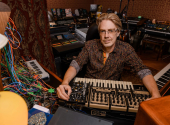
I would say it’s often watching the film repeatedly and then watching scenes over and over. It’s not always piano. I’m a better guitar player than a piano player. A lot of times I’ll go to the guitar or the bass. Sometimes I’ll go to the piano. I tend to go to acoustic instruments first. I prefer to write themes on acoustic guitar, acoustic piano, or acoustic bass because it vibrates—it feels more inspiring. I’ll record ideas on the iPhone, then usually go for a walk or make dinner. And almost always, the themes come to me not in the studio. Ninety-five percent of the time. I don’t know why. They come when I’m out walking or in the shower or cooking. Then I run back and record it. I think it’s subconscious. It’s like when you can’t remember something, and then later it just comes to you. Your brain opens when you stop trying.
Final territory, and I want to push on something that might be uncomfortable. You have composed for some of the most technically demanding prestige projects of your generation — Mass Effect, The Boys, Agent Carter — and you have also composed for Disaster Movie, Meet the Spartans, and the Alvin and the Chipmunks franchise. Some composers would say that kind of range is a sign of commercial flexibility. Others would say it's the sign of a composer who has never built a wall between art and craft. Which of those is true for you? And has that philosophy cost you anything?
Yes, and yes. It takes the same muscles. It’s still storytelling—melody, harmony. The difference is your ability as a storyteller. Some composers are great at drama but not comedy, or vice versa. I think I can do all of it pretty well. The downside is that most of the time, no one’s going to pick up the phone and say, “Get me that guy.” Because I can do everything, there’s no single identity. So maybe I don’t get those prestige, Oscar-type projects. But I’m very busy. There’s always work. And I like the variety. Like with Henry Mancini—I love that he could do The Pink Panther and something completely different. I always thought that was amazing.
Last question. You said your favorite score of all time is Ennio Morricone’s The Mission—and that "Gabriel’s Oboe" was the piece your wife walked down the aisle to. Do you think that kind of radical simplicity can be learned, or is it a gift?
It’s a gift of formal training. Ennio is one of the only people who could do that over and over again. It’s deceptively simple. It doesn’t show off the way Jerry Goldsmith or Elliot Goldenthal show off. It feels simple and unique and authentic—and that simplicity is what makes it stand out.
If you have found an error or typo in the article, please let us know by e-mail info@insounder.org.