

Rufus Miller: The most important thing in a band is to listen to each other
“A homage to late 80s, early 90s or even early 2000s, alternative, grunge, psychedelic.” This is how guitarist and singer Rufus Miller describes his own music. He is often noted as a son of Dominic Miller, the longtime guitarist of Sting. Rufus himself was also part of Sting’s touring band for six years. His music, however, is well worth listening to even without reference to more famous names. Why does Rufus like to tour in the Czech Republic so often? And what is enriching about the collective songwriting process? We discussed all this with Rufus and his bandmates, bassist Andy Thompson and drummer Bob Kessels, during an unplanned interview after an intimate yet all the more energetic concert at Recykle Club in Tábor.
Guys, do you sometimes compose alltogether? Or is it you, Rufus, who brings the ideas and the others are following your instructions? How does it work in your current band?
Rufus: Well, for this new album me and Andy definitely wrote a lot of music together. And that was really nice. Generally I do like to collaborate. But the whole point of the last three years was to put together a really good band that could grow as a band rather than sort of a solo project. More collaborative.
So Rufus and Andy, you are working together for few years. Bob, you are a newbie in the band, aren't you?
Bob: Yeah, since last April… March.
Did you have to do an audition or just friend recommended friend?
Bob: Well, I actually played with Rufus in a different band together - Hella Morgan, a band formed by the talented North London singer Ella Morgan. That's how I got to know Rufus. And then he asked me to audition for his own band, which I think was at the end of 2024, like October, November. And then in 2025 I joined them on the road for the first time to Czech Republic, which I think was last year in June, actually.
Yeah, you have been touring here in Czech Republic a lot last year and now you're back. What's interesting in Czech Republic for you? As you just experienced during the gig, people are not dancing here that much, even if you asked them. (laugh)
Andy: We're really lucky to have a promoter here (Jana Hrušková, author note) that believes in us and is really keen on the music and Rufus' songwriting and then promoting that in the Czech Republic.
Rufus: Yeah, it's fine. Actually, I think people seem to respond to the music really well here. And we're lucky that we have this team, this family that look after us and make it really easy for us to do this. Because a lot of bands can't do this, they don't have the opportunity and we're very lucky to have it. So it might not be happening like this in other countries, but we're so grateful that it's happening here.
Yeah, so you're having much more tour-stops here in Czech Republic than in other countries around, for example Poland or Slovak Republic, aren't you?
Rufus: Well, we tried adding Poland to one of the tours we did. I think it was Novembern 24. And we found a young band who said: “Yeah, come and play.” But in the end, I think we lost money going to Poland.
We're lucky that maybe Jana is going to help us go to other territories. If not, you know, we're always happy to hear from booking agents. So it's about people in a team mostly, I guess. I need it, we need it, I think. That team, that family mentality.
What do you need from your bandmates as a band leader? What are the important skills you expect from them? Not only personally, but also musically.
Rufus. I think the most important thing about a band – it seems like the zen level thing of a band – is to really listen to your bandmates. That's the most important thing. We're all really listening to each other. And there's only three of us. So we can really focus on what each other is doing. You only have a chance of sounding good, in my case, as a frontman and guitar player, if I can do my best to make these guys sound great. That's the most important thing.
And they're doing the same for me. I think that's how great music happens. When you're in it for yourself and you're like: “It's all about me”, I think you're kind of lost already. It doesn't matter how amazing you're playing.
And for you, Andy and Bob? How do you create your own space to be creative as well as supportive? And do you have your own projects where you guys are band leaders?
Andy: I've always played with other people. You know, kind of facilitated. But that's fine. I love that. And I can have my own input. Especially in a three-piece, where everything is kind of got to be concise and to the point.
Bob: I think what I have now is perfect. What I like to do more is to serve the music and try to play what I think the music needs. And if that means that I can add some of my own to it, then I will take it. But it can also be that I just simply have to hold the beat, and that's fine, too.
For me, it's all about the music and letting the music live without, promoting your own ego, if that makes sense. Because that's a very fine line that sometimes can be crossed very easily. I try to not cross it, and I try to stay within the music aspect and not the “hey, look at me” kind of aspect of it. So, yeah, that's it.
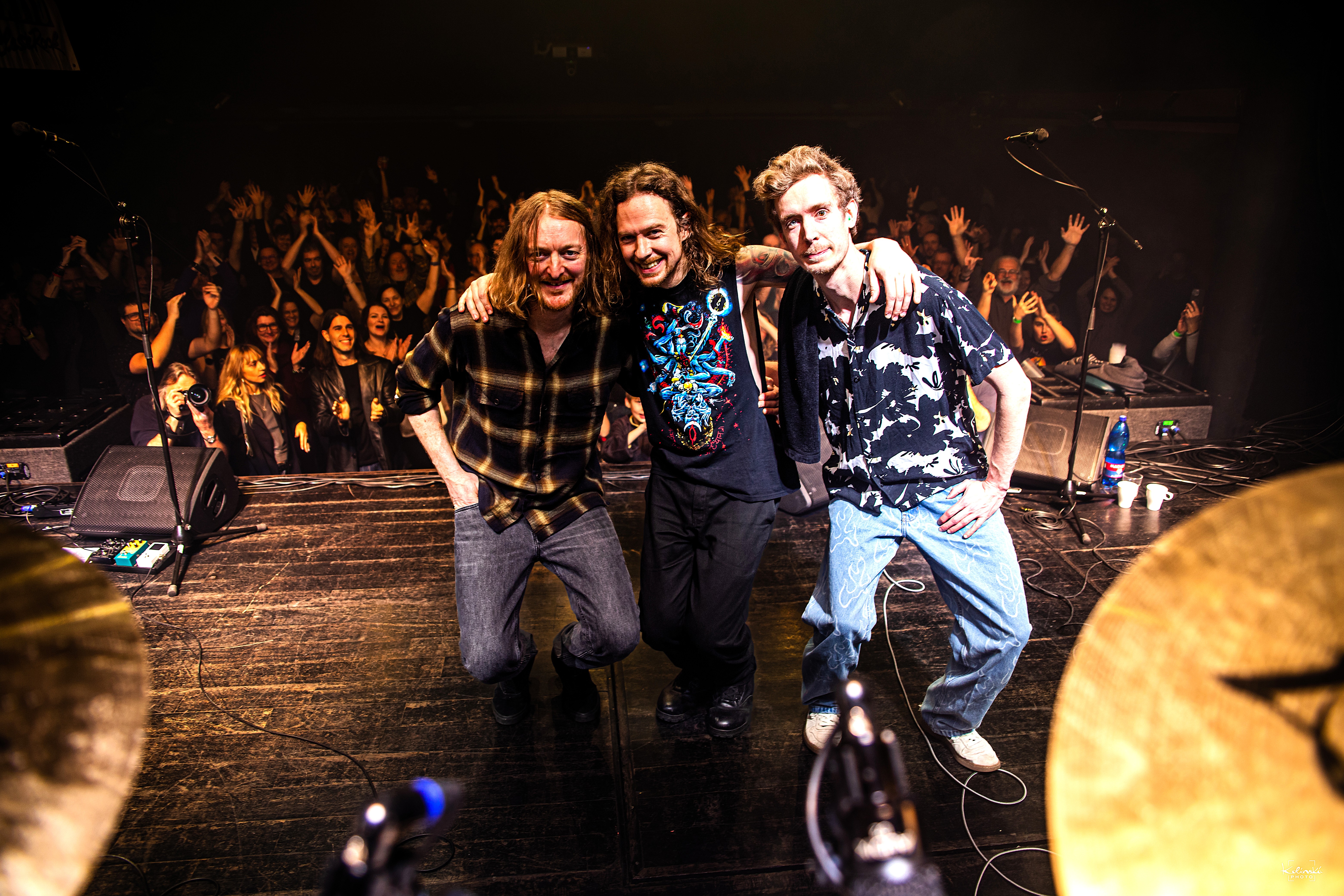
What are your musical roots? Bob, sometimes your drums felt to me a bit jazzy...
Bob: I studied music in Holland. That's where I got my B.A. in pop music. That was mostly pop and rock. But I did do a minor during my study in jazz music and also Latin American music.
Andy: I started playing rock bass when I was 15 or whatever. I played guitar before that. And then someone said: “Do you want to join our band and play bass?” So I bought bass. And then I've not really looked back.
Andy and Rufus, how did you two guys meet each other?
Rufus: So, we met at a gig in London. Southeast London, like, New Cross kind of area. And I had just stopped working with Sting. And I was like “I don't know what to do. I want to find a band. Anyone play bass?” And almost as soon as I started asking, I met Andy – through his lovely partner, Catherine. She was kind of helping make it happen. And then when I went around...
Andy: I didn't know this! I thought we just met, you know. And then I checked out his stuff and got in touch. But, no, there was... background. (laugh)
Rufus: His partner was helping. She was like: “My partner would be really good for you.” And he learned all the songs. I never had that before. When I've always done that sort of music in the past, I never had a bass player. And now I met someone, a new person, and he learned all the material. I didn't have to show him pretty much anything. And then now we're writing songs.
That's great. As I listened to all your albums at once, I just noticed, how your music has developed, emerged... Yeah, now there are quite tough bass lines. And now I see why. (laugh)
Rufus: On the first two albums I did all the bass. It's much more passive and subtle. So to have someone that can really put their personality with their playing on the bass playing and backing vocals and writing parts, it just injects a whole new life and personality. And we're all from London, so it gives it more of that sound. The first two albums were recorded in Copenhagen. So to me it's a little bit more dreamy. And now it's a bit tougher and harder, darker.
Marek Bero, a bass player, told me London scene is pretty tough. That you have to be very competitive and you still have to say: “I'm cooking something...” and play gigs for free to promote yourself etc. And tonight during the gig, Rufus, you said something like: “I've spent too much time there in London.” What did you mean with that?
Rufus: I'm from London, I was born there – and a lot of my success I feel for about six or seven years, maybe even ten years, was just constantly about moving and traveling. Yeah. And now I feel like I'm very stuck into the community in London, which I love. But I've been there for so long that… My dad put it a bit like this: “Sometimes you feel like the old sofa. It can't get rid of you.” You're no longer that kind of young, hot, fresh band. You're kind of like: “Oh, Rufus.” A bit like Lemmy or something, he's just been around – and then he went to L.A. and things happened. So there's a little bit of me that really loves coming here because I can reinvent myself here. I can start again with all these new people. It's exciting.
What other places might you consider moving to, to start over?
Rufus: I mean, Copenhagen was great. And living there for four years was awesome. It did me a world of good. But I don't know. It's hard to say. I look at the Spotify, you know, who's listening and Apple Music and everything. And it's all Netherlands, where Bob's from. So it'd be cool to live there. Also Germany, it'd be cool to live. Lots of people are listening from France. But I do love it here because I've made so many friends here now.
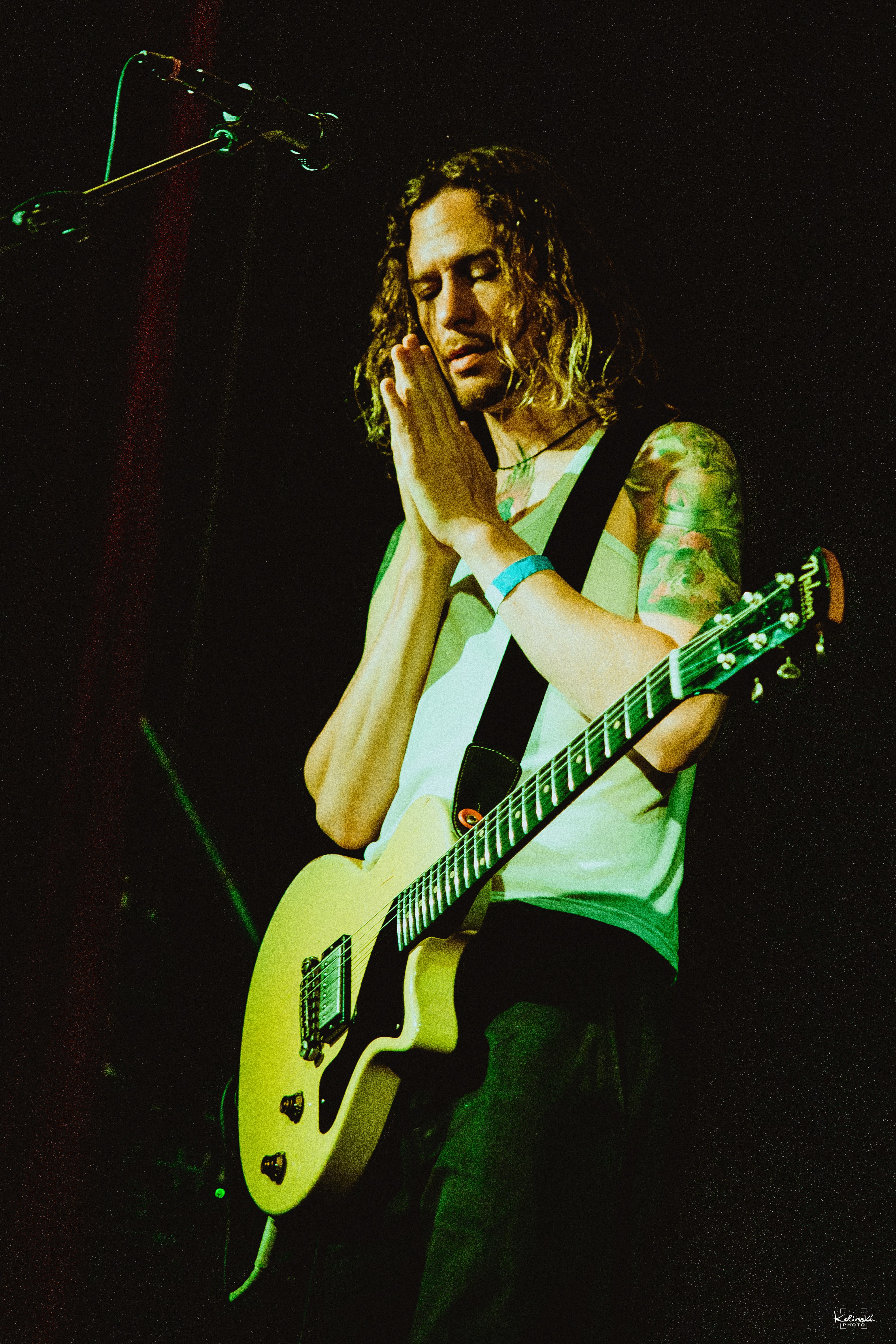
While composing new songs, can you sometimes say that some songs or certain authors are inspiring you to that extend, that their songs are getting to you almost like earworms, so that you have to try to avoid them?
Rufus: I guess, all the songs that I have written are the earworm songs where I just can't get them out of my head, or we all can't, and then I just have to finish them. So I'm looking for the earworms. I want that. I feel like that's telling me that there's something interesting there, if I just can't get it out of my head.
And then it's nice when you've got someone to write with because it's like: “I think we should finish that song, that riff, that melody. It needs another melody or another part.” Did I get your question right?
Maybe I meant more the situation, when you try to compose something new, and then in the end you realize: “Oh, it's not new. Someone else has already made it. It’s just too similar.”
Rufus: I think sometimes the best songs are when you're so into a song, but you can’t keep on to learn it. So you just do your own kind of homage... And I think what we're doing is definitely a homage to late 80s, early 90s or even early 2000s, alternative, grunge, psychedelic, that kind of movement. Because I was born in '85, so we're all kind of similar age.
And speaking of age, when were you born, Bob?
Bob: I was born in '94. So I'm about 10 years younger. Okay, okay. But it's still quite the same generation. (laugh)
Rufus, you have spent 6 years in Sting’s band, as a guitarist. And in an interview for Headliner magazine you mentioned Sting had a discipline before a show, some warm-up. Would you like to be inspired of some part of this warm-up and would you recommend it to another musicians?
Yeah. I've got to be careful because I don't want to give all his secrets away. (laugh)
Of course, if it's not a secret...
No, just basically vocal warm-ups, never drink alcohol before a show. So we all followed that. Getting places early. It's like a kind of almost military. I mean, he used to be a teacher, so he's very disciplined, focused, does vocal warm-ups, eats well, rests his voice, doesn't talk too much in between. He's always warming up with a guitar or a bass backstage. So it's like, wow, he really takes it very, very seriously to be at the highest level.
So, of course, I wanted to do the same. And everyone he attracts, the band members he attracts, do the same thing. So I've definitely taken a lot of that. These guys will tell you. I'm just always constantly going „Oooh!“ before a gig. (demonstrates a vocal warm-up)
You have been a teacher as well. You've been teaching guitar a lot. So what part of teaching process would you use as a musician on stage?
I love teaching. I've taught since I was, like, 14, 15. So it's always been my kind of job. I feel like I learn a lot from every student I teach. It doesn't matter what level they are. Everyone's got their own unique signature thing. And so I like to think that because we genre hop a lot, a lot of what I've learned from my students comes out.
Now, everyone, please name one thing, one part of your gear, which really developed your sound and helped you the most, and was like a big, big step in your playing.
Bob: For me, it would be the drum chair, otherwise I have to stand. (laugh) No, wait, I have to think about that... I mean, at the moment, I have a pretty basic setup with just three tom-toms and two cymbals. And actually, it's not really something that I'm missing, but more like because I have only one crash cymbal stand, it makes me more creative with getting most out of two cymbals instead of three cymbals. Normally, you always have a second crash next to the right cymbal.
It gives a bit more freedom, normally, to have a second crash next to the right cymbal, so you can go with both hands through crashes. But as I don't have that yet, and I also don't really need it, it makes me more creative with playing towards only one crash on the left side of the kit. It can be restrictive, but it can also open up new possibilities of playing, and phrasing fills differently. So, if anything, it's not really something specifically that I have in my kit, but it's more the setup that it is now that makes me more creative with what I have, basically. Maybe even without needing much more than I have right now, if that makes sense.
So, having less gear means having more space.
Yeah, less is more, I would say.
And for the other ones? Andy, how about you? What’s your gear hack?
Andy: Just having an instrument that you love and you're confident in its sound.
How many bass guitars do you have?
Andy: I've only got three. This one suits the sound of the band. It's a Sandberg California Central with a humbucking pickup, single humbucker. It's great. It's very playable. And it sounds big and does what I want it to do.
How about Rufus and his gear?
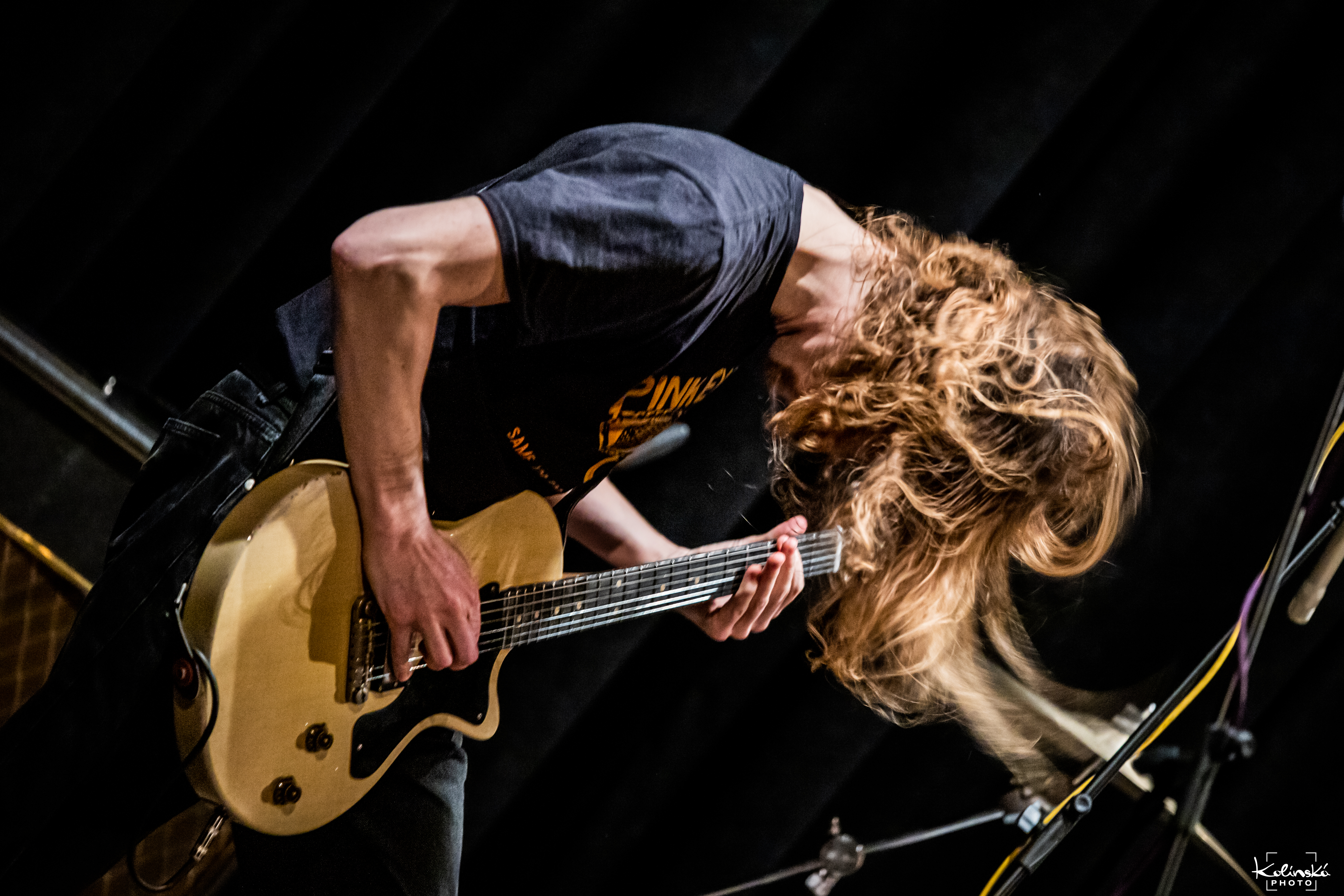
Rufus: I also like “the less is more” approach, so less pedals are better. I don't think I know anyone on the London scene with a smaller board than me, which I kind of like. But for me, the main thing is the guitar. This guitar was made for me, specced out exactly as I like. Single humbucker, coil tap. It's a Les Paul Junior kind of thing. I know it's sort of sacrilege to have a humbucker and a Les Paul Junior. But this guy just made it so well – Bruce Nelson, he makes copies of guitars and kills it out of California.
It's not so heavy. I always used to play normal Les Pauls. It's just breaking my back. This is so light, so effortless to play. It's got this grip because it's just got the one pickup. I feel also less options, so I have to create different tones with the coil tap or just the way I'm picking. And it's like a workhorse, and I'm so happy I have it.
It feels like my identity, especially with solo projects, because I'm constantly tuning, and it can handle that. But other guitars, it's a bit tricky. If you want to change the tuning, it's going to take you forever. So it's a workhorse. I love it.
Tell me more about the Wednesday gig in Akropolis, Prague. You are used to play on big stages like that, and then you came here – to a small, hidden venue in Tábor. I literally couldn't find it. It’s an insiders‘ place.
Bob: Yeah, I think it sounds a bit like a cliché, but I really believe that it doesn't matter how many people you play for, you always have to nail it anyway. And even if there's like five people and a horse and a cow sitting in front of you, you still have to bring the basket in. It goes back to the old principle of giving energy to an audience, and the audience will give it back, and it will become this kind of exchange of energy. And it doesn't really matter to me basically where you play.
Rufus: We felt the energy. We were happy boys. We were surprised, actually. It can be like that, the bigger the gig, sometimes it's harder to get a vibe. But somehow the vibe was great.
In Prague we had Vlad, he's the main guy from Cult of Fire. And we've hung out with him before, because I'm a massive metal fan, so it's really awesome to know someone that's one of the top black metal bands, or white metal, I don't know how he calls it, but it's kind of Hindu metal. And he's just such a cool guy.
And I don't know what he thought of us fully, but he loved the gig and I could see him in the audience. And there was just this feeling like everyone was on the same page. And we kept the audience. People that maybe were on the fence at that gig seemed to be like: “Oh no, this is a real thing at this stage? This is cool.”
Yeah, because in your music, you put everything together. You have a bit of grunge, a bit of hardcore, you know, these “hammers”, which is really great to dance to... And then the melodic parts and ballads, it's very colourful.
Bob: I feel like the setlist that we have now is also really well balanced in terms of quiet and happy songs and there's a nice flow in it. Yeah, I think we took the audience on a bit of a journey with how the set was built up. And I felt like Ruf already said, they were with us from the first song onwards. And there was not a moment that we felt like we had to work harder to get them back again.
If you have found an error or typo in the article, please let us know by e-mail info@insounder.org.
